Ebook Download The Book of Concord: The Confessions of the Evangelical Lutheran Church, by Timothy J. Wengert
Collection and book store are two essential places to get the books to check out. However, in contemporary period, it will certainly not just stimulate both areas. Lots of sites are currently available for the on-line collection. As right here, finding the numerous publications titles from inside as well as beyond this nation is simple. You might not just want to take guide yet also casual education. As shown, library can be an informal education system to expand the understanding, from any type of sources.
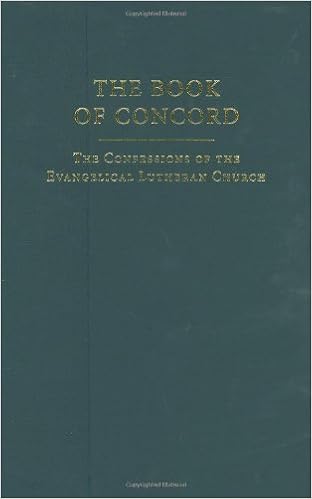
The Book of Concord: The Confessions of the Evangelical Lutheran Church, by Timothy J. Wengert

Ebook Download The Book of Concord: The Confessions of the Evangelical Lutheran Church, by Timothy J. Wengert
Envision that you obtain such particular spectacular experience as well as understanding by only reviewing an e-book The Book Of Concord: The Confessions Of The Evangelical Lutheran Church, By Timothy J. Wengert. How can? It appears to be higher when an e-book can be the finest point to find. Books now will appear in printed as well as soft documents collection. Among them is this book The Book Of Concord: The Confessions Of The Evangelical Lutheran Church, By Timothy J. Wengert It is so typical with the published publications. Nonetheless, lots of folks sometimes have no room to bring the e-book for them; this is why they can't review guide wherever they want.
Discover your own web page to be satisfied just what your requirement is. But, always remember. It is a wonderful publication. You can discover it as one of the most suggested book in this day. When you have actually discovered and got it, don't only consider the particular web page. All pages worry about useful and essential info. It will influence you the best ways to obtain the very best point while reading.
And also why should read this book? Many understand that in this era, some publications are covered in hefty things to load. Other will be also enhanced in language difficulty to comprehend. The Book Of Concord: The Confessions Of The Evangelical Lutheran Church, By Timothy J. Wengert is among the most up to date released books that has basic principle of believed with outstanding realities as well as lessons. It will teach you couple of things simple with very easy language to comprehend. Even you are from the immigrants, this publication is additionally easy sufficient to be equated.
To read The Book Of Concord: The Confessions Of The Evangelical Lutheran Church, By Timothy J. Wengert, you may refrain complex means. In this period, the provided online publication is below. Visiting this page becomes the starter for you to locate this publication. Why? We offer this type of book in the checklist, amongst the thousands of book collections to discover. In this web page, you will find the web link of this book to download. You could subsequent guide in that web link. So, when you truly need this book asap, follow up what we have informed for you below.
About the Author
Robert Kolb is Missions Professor of Systematic Theology at Concordia Seminary, St. Louis. Timothy J. Wengert is Professor of Church History at the Lutheran Theological Seminary at Philadelphia.
Read more
Excerpt. © Reprinted by permission. All rights reserved.
Introduction From the second century on Christians have expressed the biblical faith in summaries that served to identify the church's public message. The Greek word symbol--a technical word for creed--identified the function of such summaries of the church's teaching as its identifying statement of belief, purpose, and mission. The Apostles' and Nicene Creeds both offered believers guidance for public instruction and witness and also served to regulate and evaluate the public theology of the church's teachers. They demarcated lines between errors that had attacked the faith and biblical truth. When Emperor Charles V called upon the Lutheran princes and municipal governments to identify their public teaching in 1530 at the Diet of Augsburg, the Wittenberg theologians and their associates from other territories, under the leadership of Martin Luther's colleague, Philip Melanchthon, composed what they called a confession of the faith (after considering the label defense [apology]). That document, the Augsburg Confession, became recognized as the public symbol of the Evangelical Lutheran movement. It became the legal definition on which the political toleration of its adherents was based through the religious Peace of Augsburg of 1555. By 1555 the Apology of the Augsburg Confession, the Smalcald Articles, and Luther's Catechisms were also being used alongside the Augsburg Confession to describe and define what the Wittenberg reformers intended as reform and thus to regulate ecclesiastical life in various territories that had accepted the Reformation. The doctrinal controversies of the 1550s and 1560s necessitated further definition of public teaching, however, in the view of many Lutheran governments. Some of them sponsored the composition of additional confessions of faith, while others assembled confessional documents in collections called a corpus doctrinae (body of teaching). Melanchthon and other Wittenberg theologians had first used the term corpus doctrinae for the fundamental summary of the Christian faith, a term akin to analogy of faith. Later the term designated documents that could help determine the elements of the analogy of faith, and from 1560 it was employed to entitle a formal collection of such documents. In that year a printer in Leipzig, Ernst Vgelin, published a collection of the ancient creeds and eleven confessions and theological treatises from Melanchthon's pen as the Corpus doctrinae Philippicum. That collection became the legal definition of the faith in electoral Saxony in 1566 and in other lands at about the same time. Similar corpora doctrinae were published in a number of other principalities in the 1560s; they usually included Luther's Smalcald Articles and Catechisms as well as the Augsburg Confession and its Apology, along with one or more other local confessional documents. Two corpora assembled by Martin Chemnitz in 1576, for the principalities of Braunschweig-Lneburg and Braunschweig-Wolfenbttel, provided a model for the Formula of Concord. The authors of the Formula of Concord responded to objections from followers of Melanchthon who treasured the Corpus doctrinae Philippicum, and therefore they did not use the term corpus doctrinae when they prepared the Formula for publication with the ancient creeds of the church, the Augsburg Confession and its Apology, and Luther's Smalcald Articles and Catechisms after the completion of the Formula of 1577. One of the leading figures in its composition, Jakob Andreae of the University of Tbingen, was commissioned to compose a preface for this collection of documents that would speak for the princes who had sponsored the drive for Lutheran reconciliation and unity which the Formula had climaxed. In it he sketched the history of the conflicts over the interpretation of Luther's teaching. Andreae's efforts included tireless travels and diplomatic negotiations that finally brought Elector Ludwig of the Palatinate into concert with the other two leading Evangelical princes of the German Empire, the electors of Saxony and Brandenburg, August and Joachim II. These three, joined by eighty other princely and municipal governments, led 8,188 theologians into subscription of the Formula of Concord by 1580, and the Formula and other confessions were published as the Book of Concord on the fiftieth anniversary of the presentation of the Augsburg Confession, on 25 June 1580. The Book of Concord received criticism from certain quarters, particularly the followers of Matthias Flacius Illyricus regarding the doctrine of original sin expressed in the Formula, and from those whose spiritualizing view of the real presence of Christ's body and blood in the Lord's Supper led them to reject the Formula's sacramental theology and its Christology. Nonetheless, some two-thirds of German Protestants found in the Book of Concord an authoritative expression of their faith and a hermeneutical basis for interpreting scripture
Read more
Product details
Hardcover: 774 pages
Publisher: Fortress Press; 2nd edition (August 1, 2000)
Language: English
ISBN-10: 9780800627409
ISBN-13: 978-0800627409
ASIN: 0800627407
Product Dimensions:
6.4 x 2 x 9.3 inches
Shipping Weight: 3 pounds (View shipping rates and policies)
Average Customer Review:
4.5 out of 5 stars
47 customer reviews
Amazon Best Sellers Rank:
#166,434 in Books (See Top 100 in Books)
After having a chance to read more of this new translation of the Book of Concord, I still conclude that this book is--overall--very good. Yes, the translation does pluralize some areas where the original was singular, such as Luther's explanation of the Ten Commandments in his Small Catechism. Nevertheless, such pluralizations seem natural to the modern ear and tongue and do not seem a deliberate ruse to avoid using "he, him, or his," such as the explanation of who is my neighbor. The translators and editors should not have allowed these subject-verb-predicate mismatches, but were probably allowed for political correctness. However, other areas are deliberately so worded for modern correctness, such as portion of the Smalcald Articles where the translators change singulars to plurals to avoid reference to male clergy. Translators are not to make something likeable to the modern reader but make it understandable. So my first impressions were off a bit, but not much on pluralizations for political correctness.The references and historical background in the footnotes are superb and bests any BOC yet to come to print. This alone makes the book worth its purchase--so much so students of the Confessions should have this volume and use it! It was especially refreshing to see incorrect references in previous Book of Concord editions corrected in this edition.The biggest possible "problem" with this BOC is its use of Melanchthon's second Latin version of the Apology as the basis for the translation. Kolb and Wengert do make a serious case for their decision, much of which has merit. I do not have the historical or theological qualifications, however, to say definitively if using Melanchton's second Latin version was the best choice or not, but readers should be aware of this decision.In short, this edition does have some shortcomings of which readers should be aware. However, it is the most readable BOC to date and has the best footnotes of any BOC, bar none. Thus, if you want to read the Lutheran Confessions, then buy this edition and read it. However, for serious study, cross-refer this edition with the Concordia Triglotta to hone in on the original authors' intents.
I am getting quite a library started which yields a lot of information for me to study being a newcomer to the Lutheran Faith.This book is fascinating to read because it goes back to the beginning of the Reformation.
A wonderful compendium of the foundations of Lutheran theology.
Lot of reading, needed for a course, good translation.
this is a great product!
While there are a few translations of the Book of Concord around, this one does well as an alternative to Tappert's translation or the overly-cumbersome Triglotta. This translation is easy to read and the explanatory notes are well written and easy to comprehend. This is as good a translation for laymen as Tappert, and good value for money as well.
I recently joined a Lutheran (LCMS) church after becoming dissatisfied with the lack of clear doctrine in my old church. I read most of this book to familiarize myself with Lutheran doctrine prior to joining the new church. This book provides a very solid doctrinal foundation and provides insight into the foundational principles of the Lutheran church. It also provides insight into the problems in the Roman Catholic church in the 1500s.This is not for a casual reader. It is a challenging read and requires that you pay attention to the arguments being developed. But I found that it was worth the effort. My faith was strengthened by the clear defense of foundational principles (e.g. justification by grace through faith on account of Christ).While I recommended Luther's Small Catechism with explanations to all Christians, I can only recommend this to Christians ready to put in the effort to deepen their understanding of the foundational principles of the faith. Much more challenging than the typical Christian bookstore fare, but also more rewarding.
Before you go to your pastor with questions, have this handy. If you study this half as much as you study your Bible, you are on your way to being an educated disciple.
The Book of Concord: The Confessions of the Evangelical Lutheran Church, by Timothy J. Wengert PDF
The Book of Concord: The Confessions of the Evangelical Lutheran Church, by Timothy J. Wengert EPub
The Book of Concord: The Confessions of the Evangelical Lutheran Church, by Timothy J. Wengert Doc
The Book of Concord: The Confessions of the Evangelical Lutheran Church, by Timothy J. Wengert iBooks
The Book of Concord: The Confessions of the Evangelical Lutheran Church, by Timothy J. Wengert rtf
The Book of Concord: The Confessions of the Evangelical Lutheran Church, by Timothy J. Wengert Mobipocket
The Book of Concord: The Confessions of the Evangelical Lutheran Church, by Timothy J. Wengert Kindle


0 komentar:
Posting Komentar